
rounded play button chevron hamburger X Pinterest

John Canning

John Canning & Co., Cheshire, Connecticut
Decorative Painter
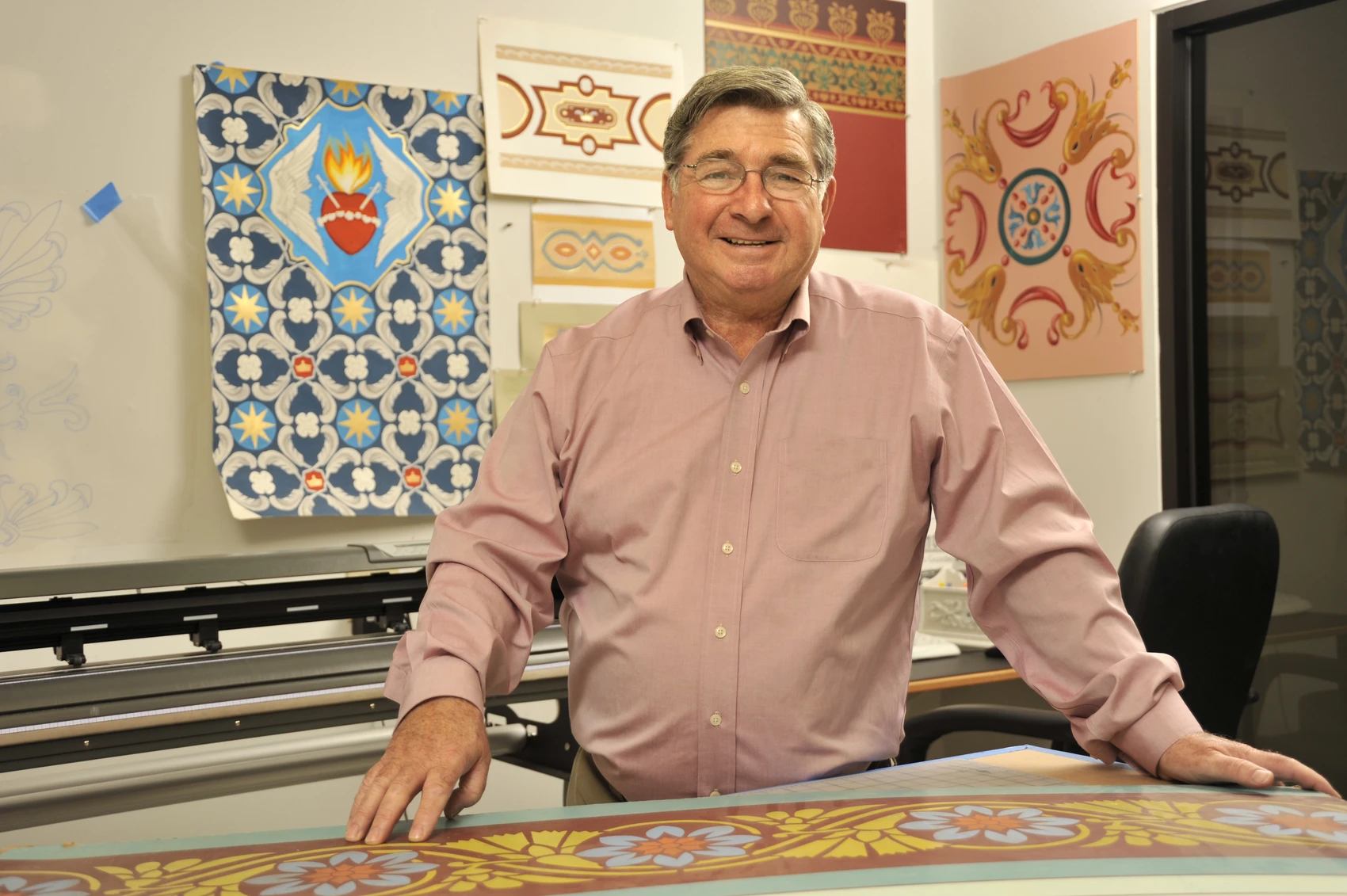
A man in a light pink shirt stands at a worktable in his studio with a variety of colorful decorative paintings on the wall behind him.
Decorative painter John Canning in his studio. Photo by Peter Billard, courtesy of John Canning & Co. 
“It’s like being an archeologist—pulling away layers of paint and discovering the original decoration and the wonderful craftsmanship of the past and then trying to replicate that.”

John Canning is one of the great masters of the decorative painting tradition. A pivotal force in the preservation of historic American architecture, he and his talented team of artisans at John Canning & Co. have restored many of our nation’s most important historic buildings. “I look at myself as being a link between the past, the present, and the future,” he says of his restoration work. 

Canning learned his trade in his hometown of Glasgow, Scotland, where he served a five-year apprenticeship as a church decorator, while also attending the Scottish Decorative Trade Institute, Stow College of Building, and night classes at the Glasgow School of Art, earning the prestigious London City & Guilds certificate. “I worked with tradesmen who were around at the turn of the century, or at least the 1920s, so it could perhaps be said that I have the accumulated experience of about a hundred years,” he says. “I always remember that period as being a very happy period of being part of a family, with the elder tradesmen looking after the apprentice, almost like a father, uncle, son or nephew relationship.”  
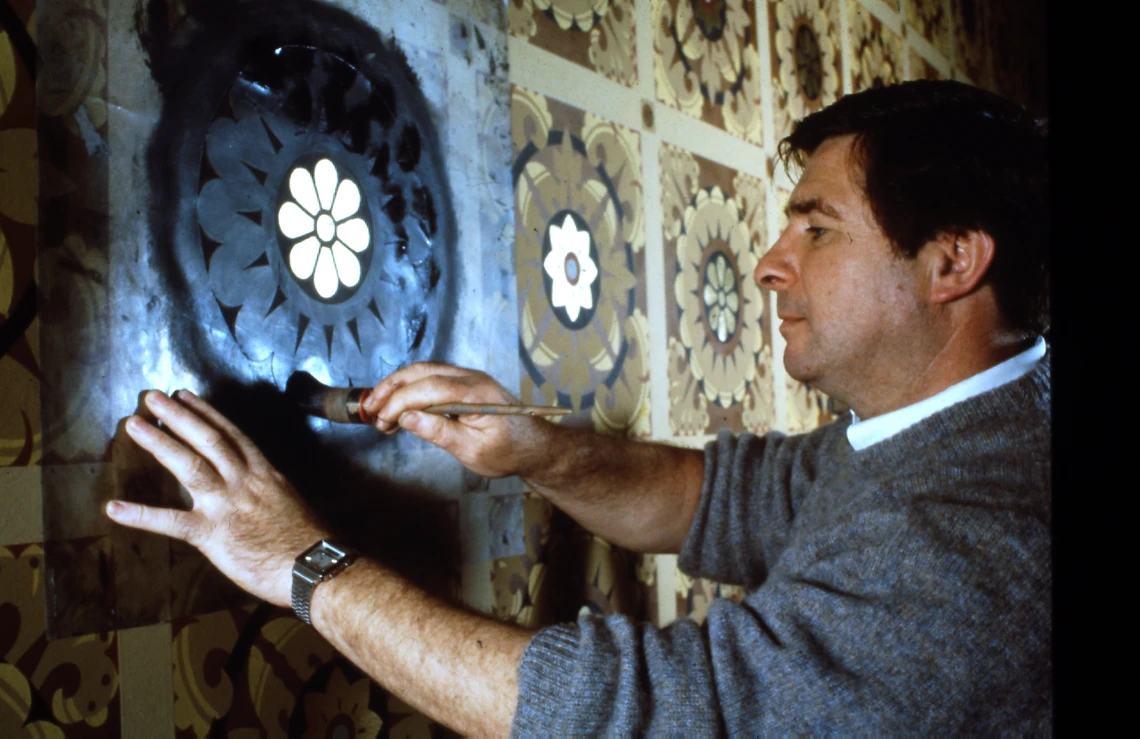
A man uses a paintbrush to paint a dark blue color onto a flower-shaped stencil attached to a wall; the colors of the finished painted decorations next to the piece he is stenciling are shades of brown and tan with dark blue accents.
John Canning stenciling decorative paint finishes during the restoration of the Connecticut State Capitol. Photo courtesy of John Canning & Co. 

Like most new apprentices, he started out doing “all the most menial tasks,” learning by watching and getting a feel for the work, gaining knowledge of terminology, paint pigments, tools, and techniques. An early experience as a young “slab boy” delivering supplies with a wheelbarrow to various job sites throughout the city cemented his desire to learn and practice the craft. He recounts how at first he felt deeply discouraged with the trade after dropping off paint supplies at an old, dilapidated church that seemed beyond all hope of repair. How could this ever be a rewarding profession? When he returned to the site several months later, he was astonished at the amazing transformation wrought by the hands of experienced tradesmen. “This church, it was a revelation to me,” he says with excitement. “It was so beautiful!” Canning never looked back; the work of a decorative painter restoring beauty and life to old buildings was the career for him.
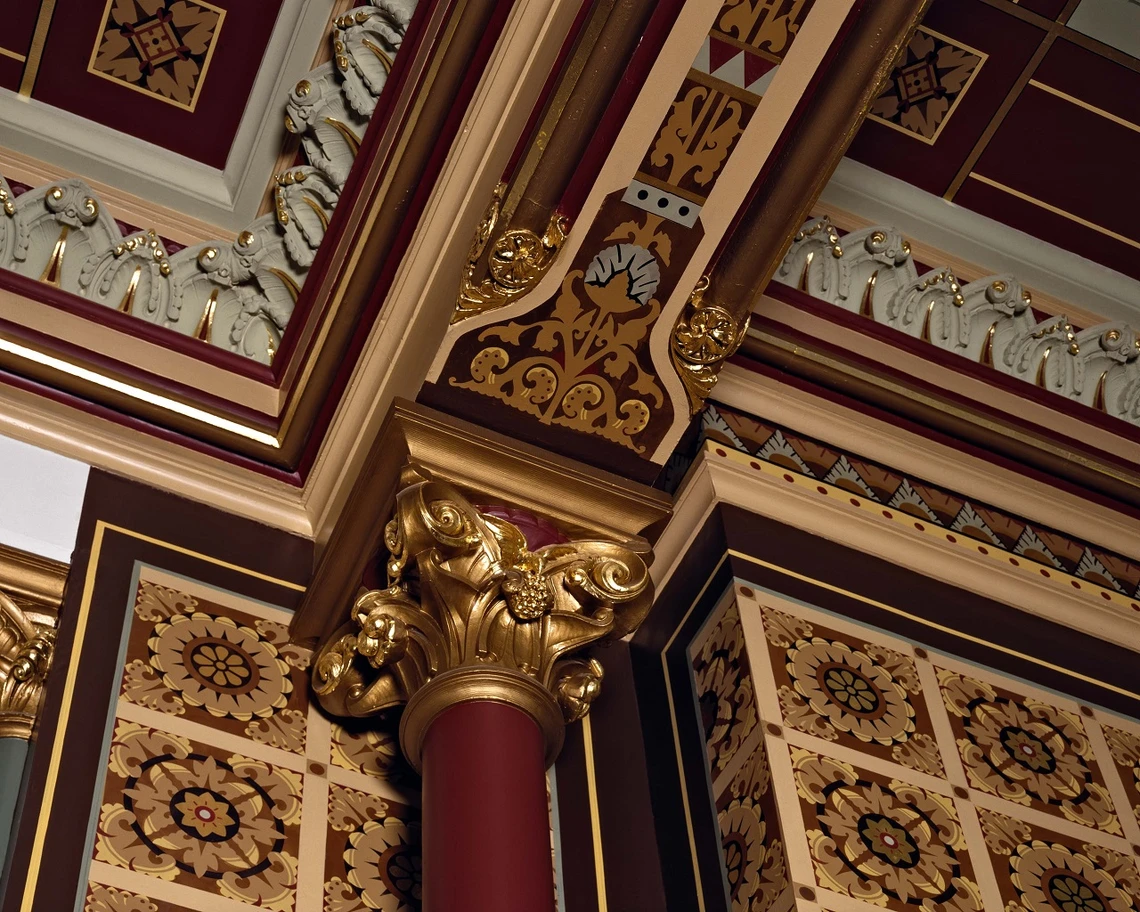
Close-up details of an elaboratively decorated room with painted brown, tan, and black floral patterns on the walls and ceiling and a gilding capital on top of a red-brown column.
Detail of decorative painting at the Connecticut State Capitol restored by John Canning and his team of artisans. Photo by Robert Benson, courtesy of John Canning & Co.

In the early 1970s, Canning immigrated with his family to the United States, bringing his old-world decorative skills and knowledge with him. He founded his own company in 1976, John Canning Ornamental Painters and Church Decorators (now John Canning & Co.), a family-run business that is nearly fifty years old. One of his first restoration jobs involved uncovering and reinstating the beautiful original 1870s decorations for Battell Chapel at Yale University, followed by a major restoration of the Connecticut State Capitol. Over the years, he and the skilled artisans at John Canning & Co. have helped to preserve some of the country’s most significant historic buildings, including Grand Central Terminal, the U.S. Capitol, the U.S. Treasury Building, Boston Public Library, the National Building Museum, Radio City Music Hall, and Trinity Church Boston, among many others.
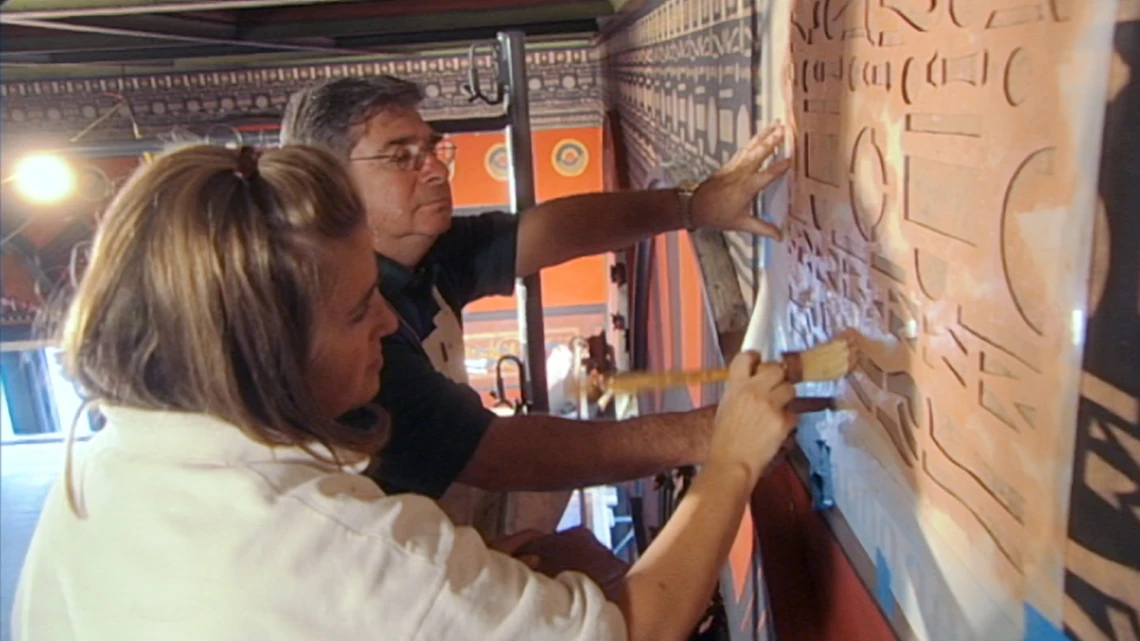
An older man and young woman work side by side in scaffolding near the ceiling of an historic church brushing tan-colored paint onto a hand-cut stencil of decorative geometric motifs that is taped to an interior wall; the bright orange colors of other parts of the church’s walls are in the background.
John Canning and his daughter Jacqueline Canning Riccio use a stippling technique on hand-crafted stencils to restore decorative paint finishes dating to 1877 at historic Trinity Church in Boston. Photo by Marjorie Hunt

A dedicated teacher and proud tradesman, Canning has passed his craft knowledge on to his daughters, Jacqueline Canning Riccio and Dorothea Canning-Hennessey, son-in-law David Riccio, and two of his granddaughters, Isabella and Zoe Riccio, all of whom are integrally involved in the family business. He developed an apprenticeship program for the state of Connecticut, has taught many young journeymen the trade, and continues to generously share his knowledge through numerous workshops and presentations for students and professionals in the field.
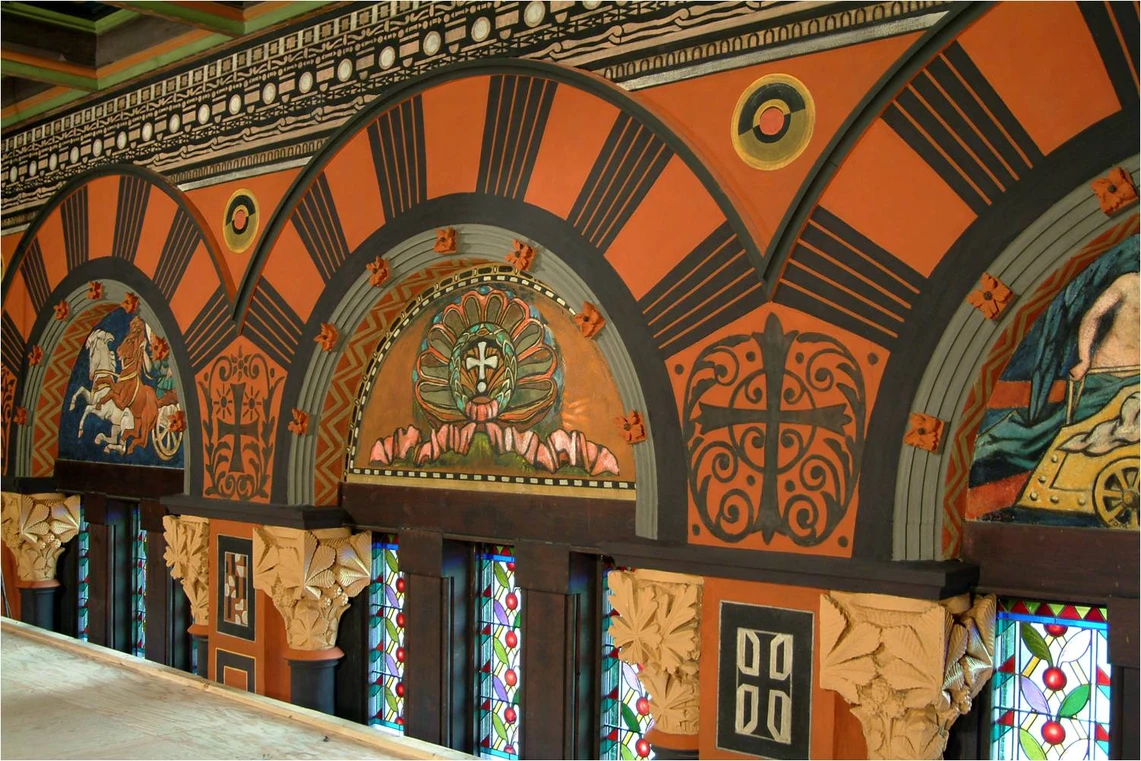
A wall near the ceiling of an historic church is decorated in a variety of decorative motifs and colors, including a border of black and tan geometric decorations above orange semi-circles surrounding beautifully painted scenes of chariots with horses and stylized crosses.
Decorative painting details at historic Trinity Church in Boston restored by John Canning & Co. Photo by Marjorie Hunt

One of things that Canning loves most about his work is conducting research on the historic buildings that he and his family are restoring, seeking to discover and faithfully replicate the style, techniques, brushstrokes, materials, colors, and character of the original decoration. “It’s so important to understand the original methods of execution. It’s important to be able to recognize and respect them, and also the materials. It’s important to understand all of these things before we start to even put our hands on it,” he emphasizes.  
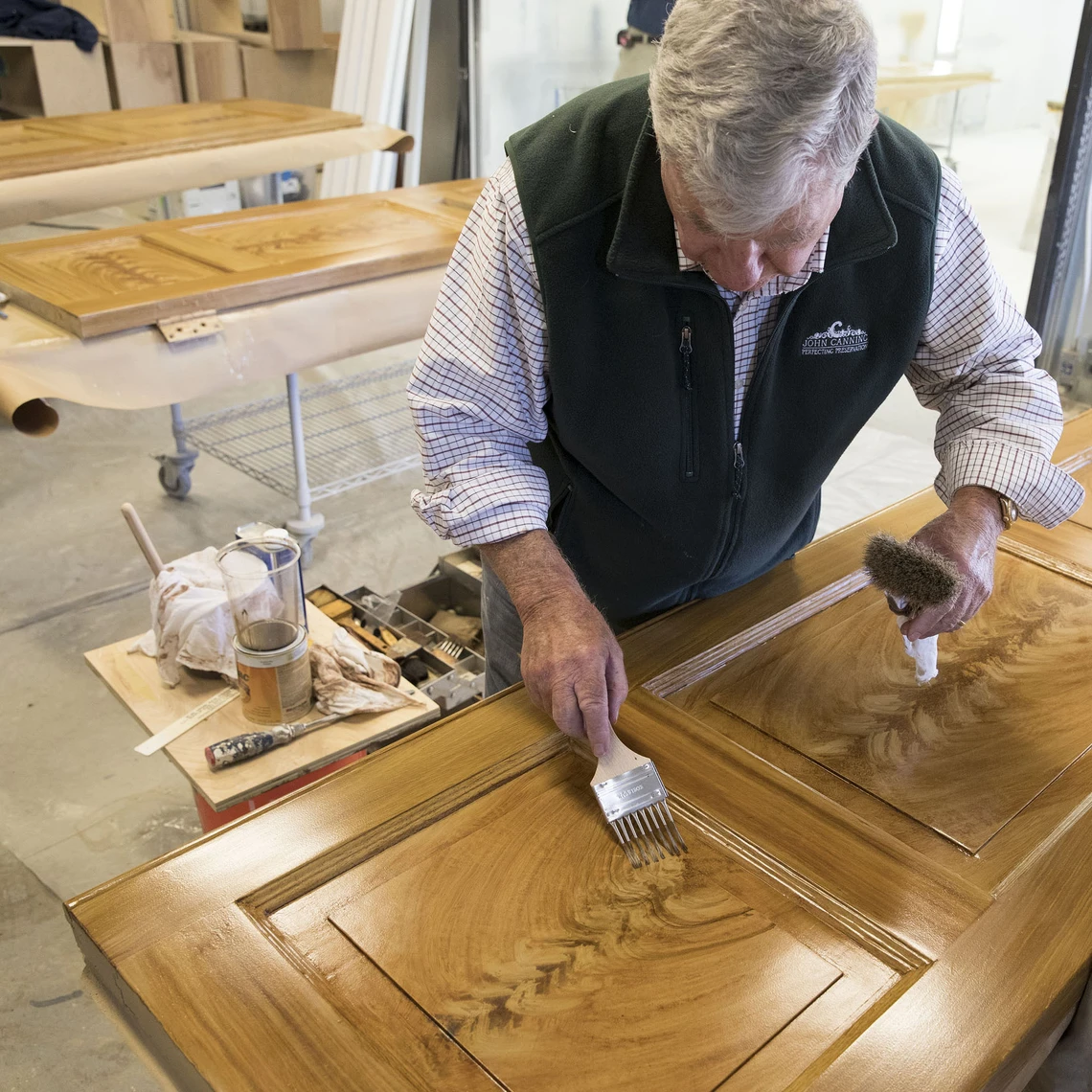
An older man in a workshop uses a comb-like brush to apply brown paint to a door on a worktable to imitate the patterns and colors of wood.
John Canning is an expert at woodgraining, a decorative painting technique that mimics the patterns and textures of different types of wood. Photo courtesy of John Canning & Co. 

While he excels in all aspects of the trade from stenciling, striping, and gold leafing, to trompe l’oeil and mural painting, it is woodgraining—a painting technique that mimics the texture of wood—that holds a special place in his heart. Using a wondrous variety of brushes and other specialty tools—badger brushes, stippling brushes, floggers, mottlers, overgrainers, steel combs—plus the all-important traditional binding ingredient—beer—he masterfully imitates the grain and color of different woods, whether mahogany, oak, or maple.
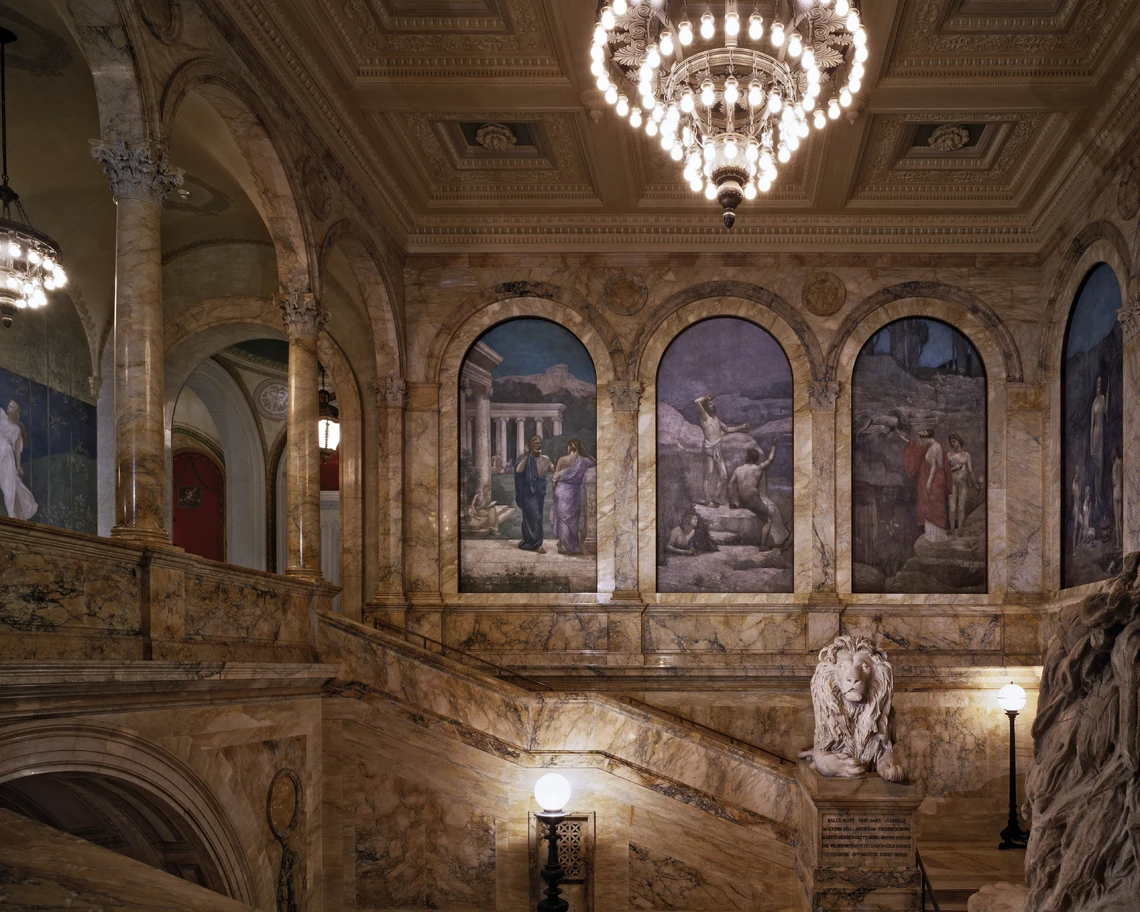
An elaborately decorated interior section of the Boston Public Library is filled with marble walls, columns, and a staircase; several large, painted murals decorate the walls, and a carved lion sits atop the staircase banister.
John Canning and a talented team of artisans from John Canning and Co. restored decorative finishes at the Boston Public Library. Photo courtesy of John Canning & Co.

No matter what the project, large or small, restoration or new work, Canning strives above all for excellence. “What gives us the most pride and satisfaction is the old adage, ‘a job well done,’” he says.

This partial image of Grand Central Terminal’s green star-studded ceiling shows the gold outlines of a galloping horse with wings; several carved ornamental arches are visible along the bottom of the ceiling.
Detail of the legendary sky mural ceiling at Grand Central Terminal in New York City, restored by skilled artisans at John Canning & Co. Photo by Robert Benson, courtesy of John Canning & Co.
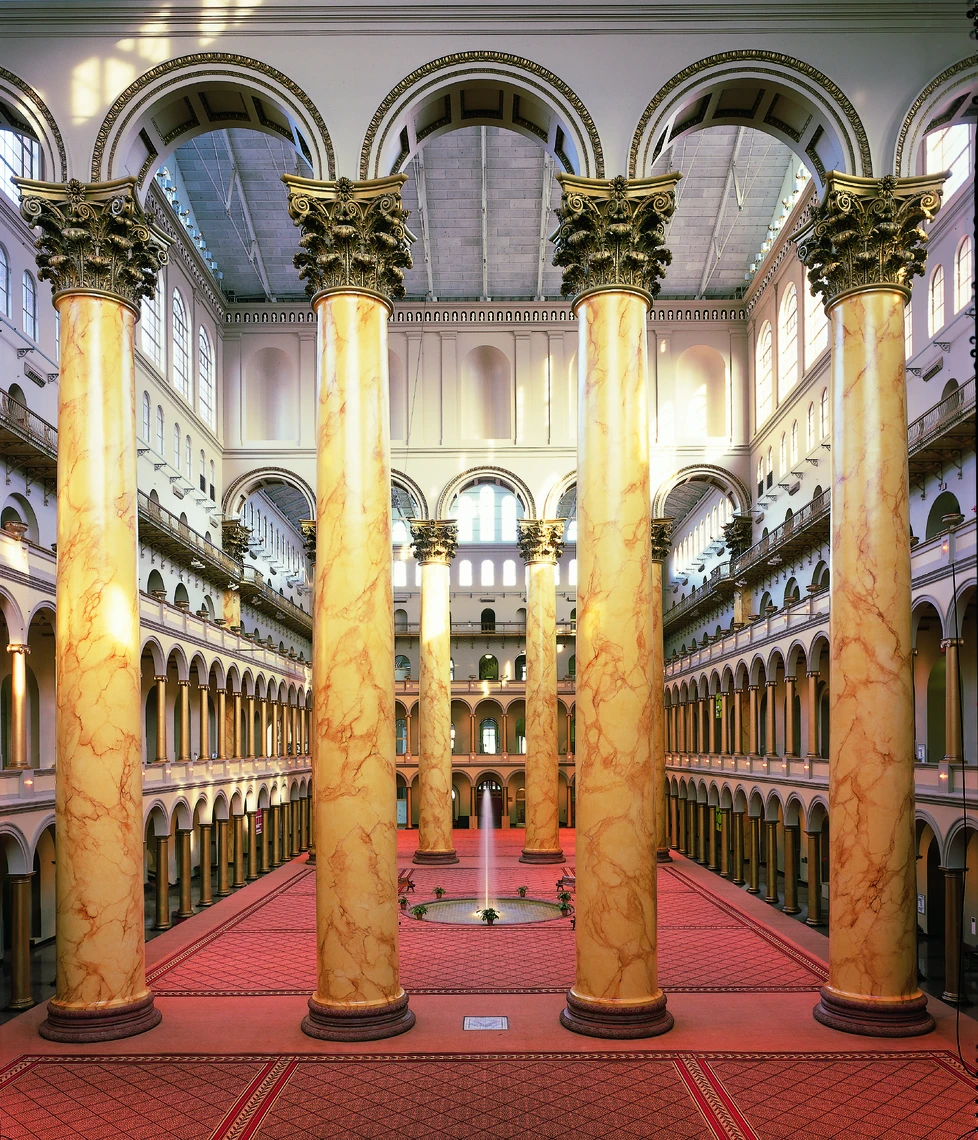
Five giant faux-marble columns topped with Corinthian capitals are seen filling the Great Hall of the National Building Museum.
Skilled artisans at John Canning & Co. restored the faux marble columns in the Great Hall of the National Building Museum in Washington, D.C. Photo by Robert Benson, courtesy of John Canning & Co. 

Learn More

Share

View By:

Credits

Sponsors

Smithsonian Women‘s Committee

This project has been made possible by the generous support of the Smithsonian Women’s Committee.

Additional support was provided by the University of Notre Dame School of Architecture.

Built by Hand: Skilled Artisans in the Traditional Trades was produced by the Smithsonian Center for Folklife and Cultural Heritage in collaboration with the University of Notre Dame School of Architecture. 


Smithsonian Women‘s Committee

This project received funding from the Smithsonian’s Our Shared Future: 250, a Smithsonian-wide initiative supported by private philanthropy and created to commemorate the nation’s 250th anniversary and advance the Smithsonian vision for the next 250 years.

Exhibition

Curator

Marjorie Hunt

Editor

Elisa Hough

Interns

Ben Cook, Lydia Desormeaux, Claire Egelhoff, Lucy Florenzo, Peyton Hoffman, Mary Bridget Jones, Maria Maxwell, Connor Roop

Project Support

Sloane Keller

Advisors

Christina Butler, American College of the Building Arts; Christine Franck, INTBAU USA; Jonn Hankins, New Orleans Master Crafts Guild; Stephen Hartley, University of Notre Dame School of Architecture; Alejandro Garcia Hermida, Traditional Building Cultures Foundation; Michael Lykoudis, University of Notre Dame School of Architecture; Stefanos Polyzoides, University of Notre Dame School of Architecture; Nicholas Redding, The Campaign for Historic Trades; Moss Rudley, National Park Service Historic Preservation Training Center; Steven Semes, University of Notre Dame School of Architecture; Simeon Warren, National Park Service National Center for Preservation Technology and Training; Harriet Wennberg, International Network for Traditional Building, Architecture & Urbanism (INTBAU)

Special Thanks

Betty Belanus, Marquinta Bell, Halle Butvin, Allen Carroll, Paloma Catalan, Kevin Eckstrom, Mimi McNamara, Arlene Reiniger, Colin Winterbottom, Erin Younger

Web Development

Design & Programming

Visual Dialogue

Content Migration

Ben Hatfield

Web Support

Elisa Hough

Archives Support

Cecilia Peterson
David Walker


Resources